
At Scholartude, we don’t just prepare students for NEET — we nurture future doctors with personalized attention, expert faculty, and result-driven strategies.
Our Offline NEET Course is designed to build strong conceptual understanding and exam temperament in a focused, distraction-free environment.
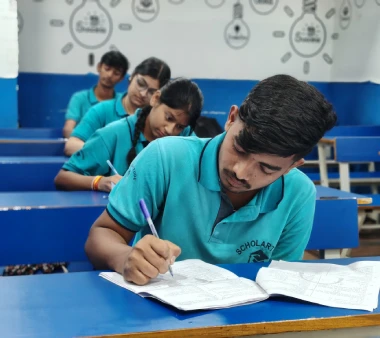

For NEET Aspirants
Faculty: Anubhuti Ma'am
Batch Duration: 2 Years
Time: Mon - Sat, 10.45am - 11.45am

For NEET Aspirants
Faculty: Sangha Ma'am
Batch Duration: 2 Years
Time: Mon - Sat, 1.15pm - 2.15pm

For NEET Aspirants
Faculty: Sangha Ma'am
Batch Duration: 2 Years
Time: Mon - Sat, 2.45pm - 3.45pm

For NEET Aspirants
Faculty: Abhishek Sir
Batch Duration: 2 Years
Time: Mon - Sat, 9.00am - 10.00am

For NEET Aspirants
Faculty: Abhas Sir
Batch Duration: 2 Years
Time: Mon - Sat, 11.45am - 12.45pm

For NEET Aspirants
Faculty: Abhishek Sir
Batch Duration: 2 Years
Time: Mon - Sat, 3.30pm - 4.30pm

For NEET Aspirants
Faculty: Harshita Ma'am
Batch Duration: 2 Years
Time: Mon - Sat, 8.00am - 9.15am

For NEET Aspirants
Faculty: Shubhangi Ma'am
Batch Duration: 2 Years
Time: Mon - Sat, 12.00pm - 1.00pm

For NEET Aspirants
Faculty: Arjun Sir
Batch Duration: 2 Years
Time: Mon - Sat, 1.15pm - 2.15pm

For NEET Aspirants
Faculty: Lucky Sir
Batch Duration: 2 Years
Time: Mon - Sat, 9.40am - 10.30am

For NEET Aspirants
Faculty: Lucky Sir
Batch Duration: 2 Years
Time: Mon - Sat, 2.30pm - 3.30pm

For NEET Aspirants
Faculty: Tanvir Sir
Batch Duration: 2 Years
Time: Mon - Sat, 12.00pm - 1.00pm
From cracking tough concepts to building confidence for the exam day, our offline program gives you everything needed to shine in NEET and secure your dream medical seat.


Focused NEET classroom sessions with expert guidance and concept clarity.

NEET-based notes, NCERT booklets, and practice sheets for revision.

One-on-one expert guidance for NEET doubts after every class.

Monthly NEET mock tests to improve speed, accuracy, performance.
Offline learning offers a focused environment for real-time guidance and holistic development
NEET UG 2027 will be a single-stage, offline exam. No changes expected from 2026 pattern.
| Subject | No. of Questions | Marks |
|---|---|---|
| Physics | 45 | 180 |
| Chemistry | 45 | 180 |
| Biology (Botany + Zoology) | 90 | 360 |
| Total | 180 | 720 |
Question Type: Multiple-choice with 4 options.
Mastering the pattern can improve scores by 50-100 marks.
The exam is qualifying for 15% All India Quota seats and state counseling.
The syllabus is based on NCERT Class 11 & 12. Total: 20 units.
Weightage: Mechanics (25%), Electrodynamics (20%), Modern Physics (15%).
Divided into Physical, Inorganic, and Organic Chemistry. Total: 30 units.
Weightage: Organic (30%), Physical (25%), Inorganic (25%).
Covers Botany and Zoology from NCERT Class 11 & 12. Total: 10 units (90 questions).
Weightage: Human Physiology (20%), Genetics (18%), Ecology (12%). Focus on diagrams and processes.
Download: Official PDF from nta.ac.in (expected January 2027).
NTA allots centers based on preferences during registration. Total: 552 cities in India + 14 abroad. Exact center revealed on admit card.
| State/UT | Sample Cities/Codes |
|---|---|
| Andaman & Nicobar | Port Blair (1101) |
| Andhra Pradesh | Amaravati (1211), Anantapur (1212), Guntur (1213) |
| Arunachal Pradesh | Naharlagun (1201) |
| Assam | Dibrugarh (1301), Guwahati (1302) |
| Bihar | Bhagalpur (1401), Gaya (1402), Patna (1403) |
| Chandigarh | Chandigarh/Mohali (1601) |
| Chhattisgarh | Bhilai (1701), Bilaspur (1702) |
| Delhi | Delhi (1602) |
| Goa | Panaji (1801) |
| Gujarat | Ahmedabad (1901), Surat (1902) |
| Haryana | Ambala (2001), Faridabad (2002) |
| Himachal Pradesh | Hamirpur (2101), Shimla (2102) |
| Jammu & Kashmir | Jammu (2201), Srinagar (2202) |
| Jharkhand | Dhanbad (2301), Ranchi (2302) |
| Karnataka | Bengaluru (2401), Hubli (2402) |
| Kerala | Kochi (2501), Trivandrum (2502) |
| Madhya Pradesh | Bhopal (2601), Indore (2602) |
| Maharashtra | Mumbai (2701), Nagpur (2702) |
| Tamil Nadu | Chennai (3701), Madurai (3702) |
| Uttar Pradesh | Agra (4001), Lucknow (4002), Noida (4003) |
| West Bengal | Kolkata (4201), Siliguri (4202) |
Abroad Centres: Dubai, Kuwait, Sharjah, etc. (14 total).
Tips: Choose 3-4 preferred states. Allotment is random; report discrepancies immediately.
For 2026-26, NMC approved 11,350 new seats, totaling 1,28,875 MBBS seats (including AIIMS/JIPMER). Government seats: ~59,000 (15% AIQ + 85% state).
| Category | Total Seats | Govt Seats | Private/Deemed |
|---|---|---|---|
| MBBS | 1,08,940 | 59,265 | 49,675 |
| BDS | 27,868 | 3,500+ | 24,000+ |
| State | Govt Colleges | Total Govt Seats |
|---|---|---|
| Uttar Pradesh | 28 | 4,500 |
| Maharashtra | 25 | 3,900 |
| Karnataka | 19 | 2,850 |
| Tamil Nadu | 20 | 3,200 |
| Rajasthan | 20 | 3,100 |
| Bihar | 12 | 1,800 |
| Madhya Pradesh | 15 | 2,200 |
| West Bengal | 14 | 2,100 |
| Andhra Pradesh | 13 | 2,050 |
| Kerala | 11 | 1,650 |
| Gujarat | 16 | 2,500 |
| Punjab | 5 | 750 |
| Delhi | 3 (incl. AIIMS) | 1,250 |
| Others (Total) | 150+ | 30,000+ |
AIIMS/JIPMER: 2,000+ seats (all govt).
Note: Includes 15% AIQ reservation. Full matrix PDF available on nmc.org.in post-approval. Counseling via MCC for AIQ; state-wise for the rest.
The Scholartude NEET Course is a structured preparation program designed for students preparing for NEET-UG alongside their Class 11 and Class 12 studies.
The program combines concept-focused classroom teaching, regular practice, doubt solving, testing, performance analysis, revision and academic mentoring to help students build strong fundamentals and progressively improve their NEET preparation.
The course is suitable for:
Yes. Starting NEET preparation from Class 11 gives students sufficient time to build strong concepts and develop consistent study habits.
The two-year approach allows students to gradually progress from foundational concepts to NEET-level problem solving, testing and exam-oriented preparation.
Yes. Class 12 students can join the program depending on their academic requirements and current stage of preparation.
Students joining in Class 12 can focus on:
Yes. The NEET preparation program is structured around the prescribed syllabus for Physics, Chemistry and Biology.
The preparation focuses on understanding concepts, completing the syllabus systematically, practising questions and regularly revising important topics.
Scholartude follows a concept-to-application approach for NEET preparation.
The typical learning cycle is:
Concept → Illustration → Problem Solving → Practice → Testing → Analysis → Revision
The objective is to help students understand concepts clearly and apply them effectively to NEET-level questions.
The NEET program is supported by structured academic material and practice resources aligned with the course curriculum.
Students can use the study material for concept revision, practice, question solving and preparation for regular tests.
Yes. Doubt solving is an important part of the Scholartude learning process.
Students can clarify academic doubts arising from classroom teaching, assignments, practice material and tests.
Yes. Regular testing helps students evaluate their preparation and identify areas that require improvement.
Tests can include:
Test performance can be analysed to identify the student strengths, weaknesses and areas requiring additional preparation.
Performance analysis can help identify:
Students can then use this information to improve their preparation strategy.
Yes. NEET Previous Year Questions (PYQs) are an important part of effective NEET preparation.
PYQs help students understand question patterns, important concepts, difficulty levels and the type of questions asked in the examination.
NEET preparation requires consistent practice rather than studying only immediately before examinations.
Students should regularly work on:
Yes. Academic mentoring can help students understand their current performance, identify areas for improvement and plan their preparation.
The objective is to ensure that students receive proper feedback and direction throughout their NEET preparation journey.
Being weak in a particular subject does not mean that a student cannot improve their NEET performance.
The first step is identifying the reason for the weakness, such as:
Once the underlying issue is identified, students can follow a targeted improvement plan.
Phase 1 — Foundation
Build strong fundamentals in Physics, Chemistry and Biology.
Phase 2 — Class 11 NEET Preparation
Complete Class 11 concepts while developing consistent NEET-level practice habits.
Phase 3 — Class 12 NEET Preparation
Build Class 12 concepts while continuing systematic NEET preparation.
Phase 4 — Syllabus Completion & Testing
Complete remaining concepts and progressively move toward mixed-topic and full-syllabus testing.
Phase 5 — Revision & Exam Preparation
Focus on revision, PYQs, mock tests, weak areas, speed, accuracy and examination strategy.
The key is to integrate school studies and NEET preparation rather than treating them as completely separate academic programs.
Students should maintain:
A sustainable routine is generally more effective than studying for extremely long hours inconsistently.
Yes. Strong conceptual preparation can support both board examination and NEET preparation.
Students should follow a structured study plan that allows them to understand concepts deeply while practising the different question formats used in board examinations and NEET.
There is no single ideal number of study hours that applies to every NEET student.
The more important factors are:
Quality of Study + Consistency + Focused Practice + Revision + Testing
Students should build a sustainable daily routine rather than chasing an arbitrary number of study hours.
Scholarships, if applicable, may be linked to academic performance, scholarship tests, entrance assessments or other admission criteria.
Students and parents should check the current scholarship structure with Scholartude at the time of admission.
Course fees can vary depending on the batch, course duration, admission cycle and applicable scholarship or fee benefits.
For the current fee structure, students and parents should contact the nearest Scholartude centre.
Parents can be kept informed through structured academic communication covering areas such as:
Regular parent-teacher interactions can help parents understand the student’s progress without unnecessarily pressuring the student.
NEET preparation requires more than simply attending lectures.
Scholartude focuses on a structured learning ecosystem combining:
Concept Building + Practice + Doubt Solving + Testing + Analysis + Mentoring + Revision
The objective is to help students build strong fundamentals, improve problem-solving ability and prepare consistently for NEET.
Yes. NEET preparation should not be restricted only to students who are already academically strong.
A student with average current performance can improve significantly with:
The important question is not only where the student is today, but how consistently the student improves.
Yes. Visiting the centre can help students and parents understand the academic environment, teaching methodology, batch structure, faculty interaction and overall learning experience.
Students and parents can interact with the academic team and understand the course structure before making an admission decision.
Students and parents can contact their nearest Scholartude centre to understand the current batch schedule, eligibility, course structure, fees, scholarship opportunities and admission process.
Scholartude — Empowering students to become Scholars.
👋 Hey there! Looking for guidance on your studies? Let's talk!
Start Chat